
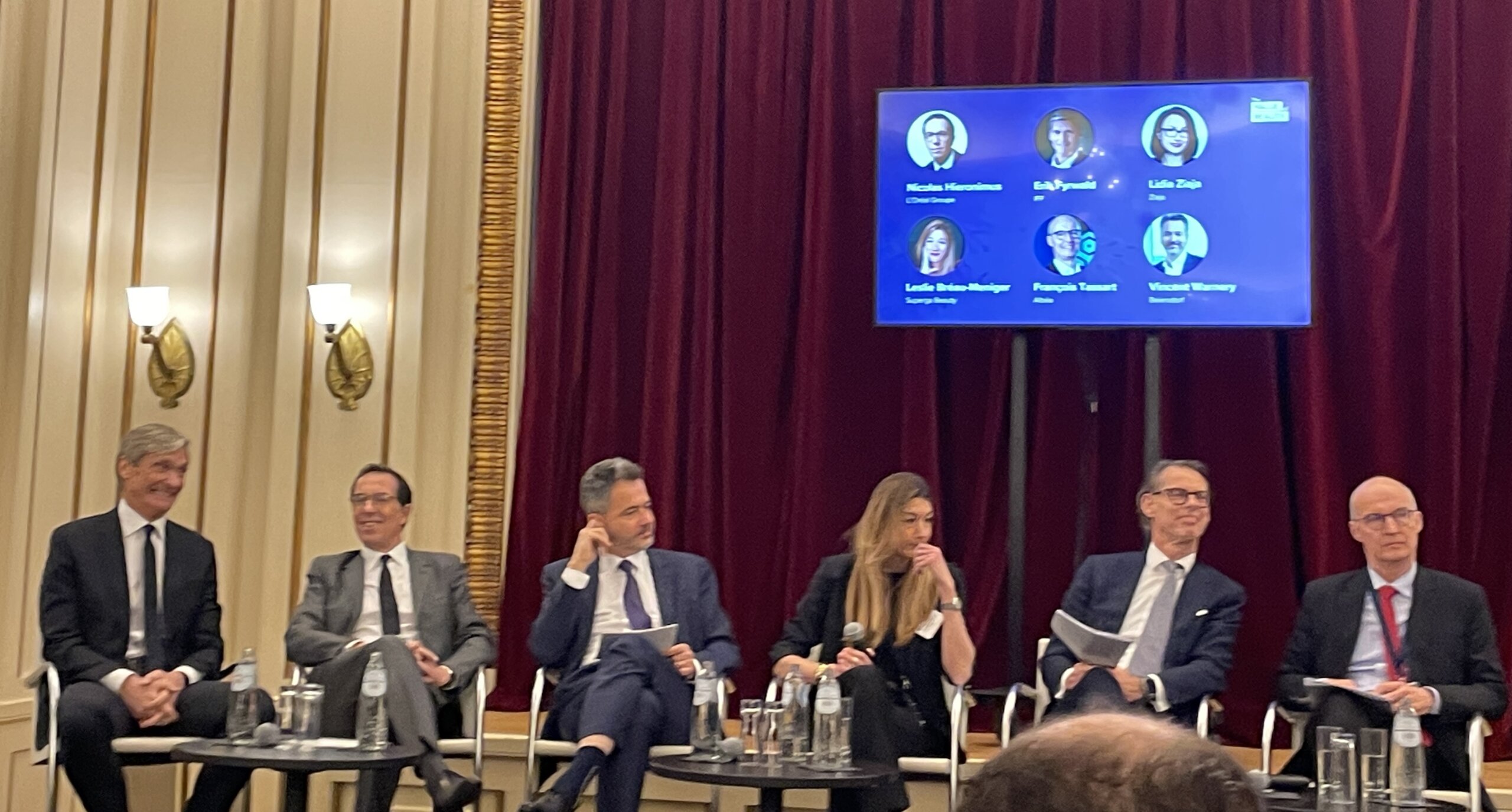
CEOs from major beauty companies under the umbrella of the Value of Beauty alliance said that the future of Europe’s beauty industry is at risk unless there is more clarity, greater simplification and better harmonization of the European Union’s (EU) cosmetics regulations.
The Value of Beauty, a grouping of 17 companies created in 2024 with the aim of giving the beauty industry a voice among European policymakers, issued what it described as a ‘wake-up call’ to Europe’s regulators at the alliance’s CEO forum in Brussels yesterday morning.
CEOs from the alliance underlined that without urgent action on regulations, Europe risks weakening one of its most competitive industries, and that policymakers need to act now to safeguard the region’s industrial champions before it is too late. The executives highlighted Europe’s leading role in the global beauty industry and its economic weight. The sector contributes €180bn to EU GDP, generates nearly €30bn in exports and supports 3.2 million skilled jobs across Europe.
Complexity & cost impact innovation
Key criticisms are that the administrative burden and cost of increasing regulations mean that companies are investing less in R&D and innovation, thereby harming their competitiveness. This comes at a time when European companies are up against fierce competition from players in other markets, particularly Asia.
“Overall, this industry spends more than €2bn every year in innovation, and most of our innovation is based in Europe,” commented L’Oréal CEO Nicolas Hieronimus. “If I take the company I represent, L’Oreal, 70% of our innovation budget and headcount are based in Europe. But unfortunately, the regulatory landscape is making things complicated. A lot of the regulation in Europe is somehow forcing an important part of our R&D budget into reformulating to comply with regulations. For some companies, up to 70% of their R&D budget is now dedicated to compliance and reformulation. So what we’re trying to communicate here is to make sure that European authorities, whether the commission, the parliament or the member states, see the beauty industry as a strategic asset for Europe, and an asset that could be challenged by a number of the regulations that are forthcoming, if they are not changed.”
The growing complexity and cost of regulations are particularly challenging for small-to-medium sized companies. Packaging company Superga Beauty President Leslie Bréau-Méniger said the cost of compliance for her company has almost doubled over the past five years. Meanwhile, cosmetics brand Ziaja revealed that the increase in regulatory changes over the past five years means that 90% of its portfolio will have been re-labelled or reformulated between 2025 and 2027.
In a statement, Hieronimus added: “We applaud [European Commission] President von der Leyen’s call to cut red tape and end gold plating across Europe. These words must now turn into action. […] Every euro lost to regulatory complexity is a euro Europe can’t afford to waste. The time has come for Europe to stop being the world’s Chief Regulator and start becoming its Chief Innovator.”
Asked whether the Value of Beauty’s message is being heard by EU policymakers, L’Oréal’s Hieronimus said: “We feel heard, but we’d like to see more action. The reality is that we indeed feel a change, both in the parliament and in the commission, with a real desire to express support for the industry and to work to make Europe more competitive […]. To some extent it doesn’t seem that the beauty industry is at the top of the priority list and that is why we are here.”
He added: “It’s going in the right direction, but I think the world goes very fast. The context is more challenging every day, and therefore, the pace of action has to be adapted just to match the world’s pace. And our competition is not slow, and it’s not waiting, so we need Europe to be fast and active.”
The PPWR and wastewater issues
Key issues for the industry are the Packaging and Packaging Waste Regulation (PPWR) and Urban Wastewater Treatment Directive (UWWTD). “On the PPWR, we all agree on the goal, but the major issue is the timing, and also the clear guidance and interpretation of some articles. Putting [this] in place in less than three years [is difficult]; sometimes it takes 10 years or 15 years to develop new packaging. We need to negotiate on the kind of implementation, step by step,” explained Albéa Group CEO François Tassart. There is also concern that the PPWR will result in less creative packs, thereby eroding the desirability of European packaging.
When it comes to the PPWR, the alliance is asking for a more pragmatic and up-to-date framework, so that companies can focus on sustainability and innovation, rather than diverting resources to navigate what it calls overly complex and unworkable rules.
In terms of the Urban Wastewater Treatment Directive (UWWTD), the industry is calling for fairer treatment. The beauty industry claims that it is responsible for 2% of water pollution, but has to pay 26% of the bill. It underlined again that the cost penalizes investment in R&D and innovation. The alliance is urging policymakers to ensure an evidence-based and proportionate application of the “Polluter Pays Principle,” stressing that its application must be science-based, fair, and that each sector should bear its fair share of responsibility.
The alliance also called for more harmonization between Europe’s regulations and those of other markets. “Trade agreements have to go beyond just tariffs or reduction of tariffs. They have to be around harmonization of regulations and intellectual property protection. Our competitors in China and Korea and other places would love to see the complexity of Europe make us weaker and so be less competitive. If the regulatory systems are aligned and fair, intellectual property protection is there, and the regulations in Europe allow us to continue to innovate and spend less time reformulating, this industry in Europe will continue to grow very nicely. That’s our opportunity. But we need that smart regulation, intellectual property protection and regulatory alignment,” explained IFF CEO Erik Fyrwald.
Views from Givaudan’s Gilles Andrier
On the sidelines of the Value of Beauty CEO Forum, Gilles Andrier former CEO of fragrance house Givaudan (who is also standing for election as Givaudan Chairman) talked to BW Confidential about how he sees the role of the Value of Beauty and the extent of the risk posed by Europe’s current regulations for the industry.

The Value of Beauty was formed in 2024. What progress has been made so far? Given the fast-paced nature of today’s market, is there a risk of any change in terms of regulation coming too late?
Gilles Andrier: On the positive side, it is good that we have the alliance, and we would have been in a worse shape if we had not started the Value of Beauty two years ago. When the alliance was created in 2024, it was about starting to get our voice heard in a soft way, to show that we exist and to create awareness. Then in 2025, we expanded the alliance to more companies and also doubled down on what we are asking for. This year, it’s really about increasing the volume and being more vocal about how the issues discussed this morning are putting the industry in jeopardy. It is timely, because of the questions today about making Europe competitive again in a world that has changed dramatically.
There are three fronts we are talking about today. The first is the Urban Wastewater Treatment Directive. Data shows that cosmetics only pollute 2% of the water, but we have to pay for 26%, so it’s unfair and other industries don’t contribute. The second is the PPWR. Sustainability is important, but at the same time, we have to be given enough space, time and money for the industry to reinvent itself. In addition, the volumes involved in terms of packaging and glass are quite minimal compared to other industries. The third issue is on ingredients and the Omnibus VI, and making the application of chemical regulations relevant to our industry and to our volumes. Banning ingredients could put the whole industry in jeopardy, give the industry in other regions a clear advantage, and the offer for consumers would change dramatically. In perfumery, a lot of ingredients could disappear from the perfumer’s palette – there is a risk that 95% of all naturals could disappear, which is absolutely crazy when you think that naturals are not harmful to consumers in the way that we use them and that consumers want more naturals.
To answer your question, yes, we are heard, but we are a bit anxious if this will translate into big changes or action. However, some industries have managed to [effect change], such as the automotive industry, which managed to slow the whole transition to electric cars.
You say the industry is in jeopardy, can you quantify how much will be lost?
Gilles Andrier: It’s very difficult to make any projections. But if you think about it, it is a €180bn industry with €30bn in exports, and products could be put in jeopardy if they are less-performing, which would allow non-European competitors to grow and take this advantage. So that’s one figure. The second figure is that 70% of R&D budgets are spent on reformulations rather than on true innovation – that is, spent on aspects that don’t really create a competitive advantage.
This ecosystem is under pressure because of increasing regulations, in terms of complexity, timeline, and also in terms of relevance to the scientific backgrounds behind those regulations. A lot of those regulations translate into increasing pressure and depleting the power to innovate for companies. Our message to the policymakers is: yes, we want to make our products safe, yes, we want to as an industry, continue to contribute to the sustainability roadmap ahead of us, but we need simpler frameworks. We need less complexity, we need more predictability, and we need realistic implementation guidelines in a fair framework, all scientifically based, so that this industry can continue to flourish.
Do European policymakers need to better take into account the weight of the beauty industry in Europe?
Gilles Andrier: In this €180bn industry, there are a lot of European leaders and they are exporting. How many industries in Europe are leading in the world? There should be more recognition that beauty is an industry where Europe leads.